
The Cable Drawer Guide: Which Old Cables, Chargers and Leads Are Worth Recycling
Thicker household cable, extension leads, vacuum cleaner cords, older heavy phone or laptop chargers, and strings of Christmas lights contain enough copper to be worth bringing to a scrap dealer, especially once you have collected a few together. Thin single leads like USB cables and modern phone cables usually contain too little copper individually to be worth the trip on their own, and are better suited to general WEEE electrical recycling.
- UK households are estimated to be holding onto as many as 627 million unused or broken cables, according to Material Focus, the organisation behind the Recycle Your Electricals campaign, enough cable laid end to end to reach the moon and back.
- Not every cable in the drawer is worth scrapping individually. A single thin phone or USB cable contains only a small amount of copper and usually is not worth a dedicated trip on its own.
- Extension leads, vacuum cleaner cords, older laptop and appliance chargers, and Christmas lights are thicker and contain meaningfully more copper, making them worth setting aside specifically.
- Accumulating several months’ worth of household cable clutter before a trip, rather than scrapping single items as they turn up, is the single biggest thing that makes household cable recycling worth your time.
- Anything you are not sure about can still be brought in. Grading happens on arrival, and there is no obligation or cost to finding out what a mixed bag is actually worth.
Why Every Home Has a Drawer Full of Cables
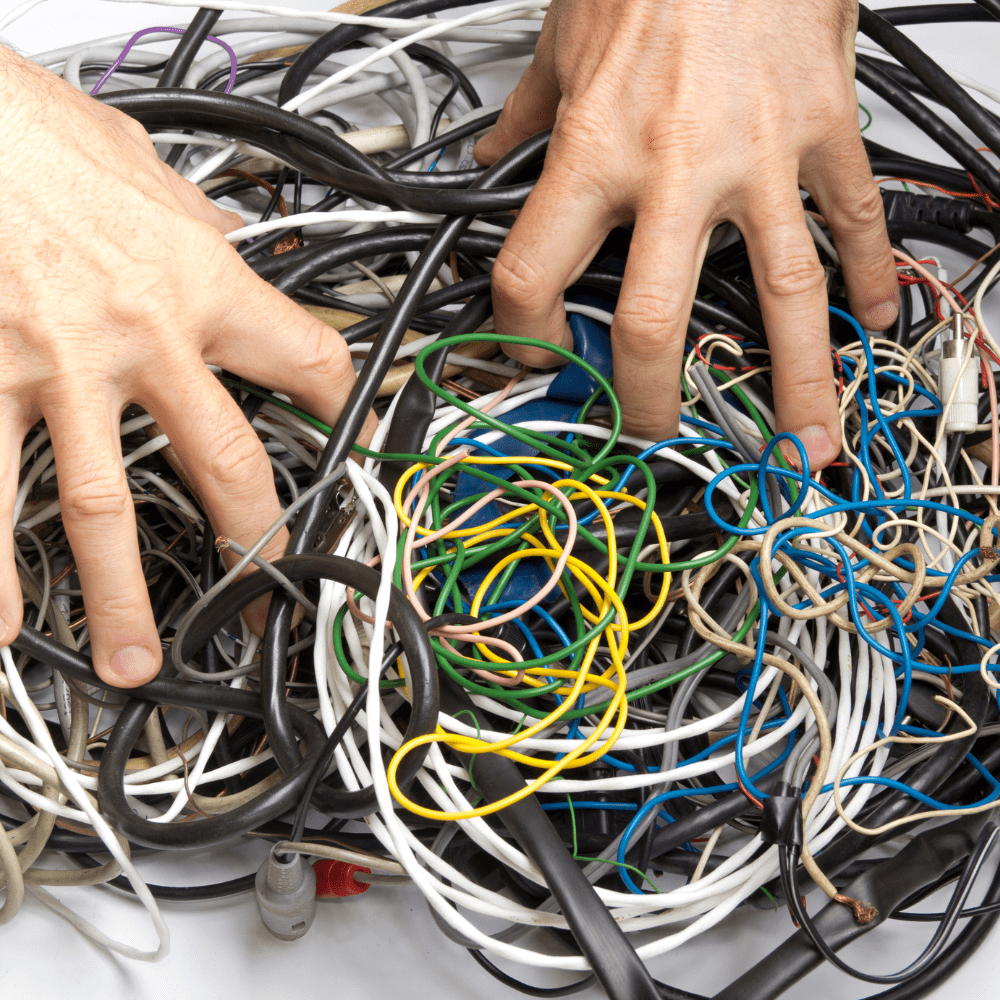
If you have a box, drawer or bag somewhere in the house full of old chargers, leads and cables you cannot quite bring yourself to throw away, you are not unusual. Material Focus, the independent not-for-profit behind the UK-wide Recycle Your Electricals campaign, estimates that UK households are holding onto as many as 627 million cables that are either broken or simply not being used, enough cable laid end to end to reach the moon and back.
Most of that pile is genuinely not doing anyone any good sitting in a drawer. Some of it is worth scrapping for its copper content, and some of it is better suited to general household electrical recycling. Knowing which is which saves you from either an unnecessary trip with material that is not worth much, or from throwing away something that was actually worth keeping and bringing in.
What Actually Makes a Household Cable Worth Scrapping
The rule that matters is the same one that applies to trade cable: it comes down to how much copper is inside relative to the plastic insulation and casing around it, covered in full in our grading guide. A short, thin cable is mostly plastic by weight, with only a whisker of copper at its core. A longer, thicker cable, or a cable with multiple conductors, carries proportionally more copper for the same length.
This is why a single phone charging cable is essentially never worth an individual, dedicated trip, but a coiled extension lead, a vacuum cleaner cord, or several metres of Christmas tree lights genuinely can be, especially once you have more than one of them.
Cables Worth Setting Aside for Scrap
Extension leads and multi socket adaptors
These are among the thickest, most copper dense cables commonly found around the home, since they are built to carry a genuine electrical load safely. A drawer of old, faulty or surplus extension leads is genuinely worth bringing in.
Vacuum cleaner cords
Vacuum cleaners use a surprisingly thick, long cord relative to their size, and old or broken vacuums are commonly discarded with the cord still attached. If you are getting rid of an old vacuum, the cord alone is worth keeping back rather than binning with the appliance.
Older laptop and appliance chargers
Older style laptop chargers, particularly the larger brick style chargers from a decade or more ago, use thicker cable than modern slimline phone chargers. The same applies to chargers for older cordless tools, older mobile phones with proprietary chargers, and similar bulkier charging equipment.
Strings of Christmas lights
A string of fairy lights or Christmas tree lights is thin per bulb, but the sheer length involved, often several metres per string, and the number most households accumulate over the years, adds up to a genuinely worthwhile amount once several strings are put together.
Old landline telephone cable and internal extension wiring
Older telephone cable, particularly anything pulled out during a rewire or a house clearance, tends to be thicker and more copper dense than people expect, since older telecoms cable was not built to the same slim, minimal standard as modern equivalents.
General appliance leads: kettles, toasters, irons, hairdryers
Kitchen and bathroom appliance cords are shorter than an extension lead but still meaningfully thicker than a phone cable, and are worth keeping aside from appliances you are disposing of rather than letting the whole appliance go to general waste with the cord still attached.
Cables That Are Rarely Worth an Individual Trip
Single phone charging cables and USB leads
A single modern phone cable or USB lead contains a genuinely small amount of copper, thin enough that even a large pile of them individually still adds up to relatively little weight. These are better suited to general WEEE electrical recycling through a retailer take-back scheme or your local recycling centre, where they will still be processed responsibly, just not through a scrap cable route.
HDMI, audio and short AV cables
Similar to phone cables, these are thin, short, and light. They are genuinely recyclable and should never go in general waste, but the copper content of an individual lead is small enough that a dedicated scrap trip for a handful of them is rarely worth your time.
Small charger bricks and plug adaptors on their own
The plastic casing and internal components of a charger brick are not scrap cable at all, and belong with general electrical waste recycling rather than a cable specific scrap route.
How to Turn a Mixed Drawer Into Something Worth Bringing In
Wait and accumulate rather than making single item trips
The economics of scrapping household cable work in your favour once you have built up a genuine collection, a shoebox or bag’s worth, rather than trying to scrap single items as they turn up. Keep a container specifically for cable clutter and empty it every few months.
Separate the thick stuff from the thin stuff as you go
You do not need to be precise about grading at home, but roughly keeping extension leads and thicker cable separate from thin phone and USB leads means the valuable portion of your collection is not averaged down when it is graded, the same principle that applies to trade cable covered in our grading guide.
Include cable from appliances you are getting rid of anyway
When a vacuum, kettle, lamp or other appliance dies, cut the cord off before the appliance itself goes to general waste or a WEEE recycling point, rather than losing that cable’s value along with the rest of the appliance.
Bring it as it is
You do not need to strip insulation, sort by exact grade, or do anything beyond a rough separation of thick from thin. Bringing a mixed bag in as it is and letting it be graded on arrival is completely normal and expected for household quantities.
Household Cable Worth Guide at a Glance
| Cable type | Worth scrapping |
|---|---|
| Extension leads, multi socket adaptors | Yes, genuinely worthwhile |
| Vacuum cleaner cords | Yes |
| Older laptop or appliance chargers, brick style | Yes |
| Christmas lights, accumulated | Yes, once you have several strings |
| Old telephone cable and internal wiring | Yes |
| Kettle, toaster, iron, hairdryer cords | Yes, worth keeping aside |
| Single modern phone charging cables | Rarely worth an individual trip |
| HDMI, audio and short AV cables | Rarely worth an individual trip |
| Charger bricks and plug adaptors alone | Not scrap cable, use general WEEE recycling instead |
What Happens to WEEE-Route Cables Versus Scrap Cable
This is worth understanding so nothing feels wasted. Cable that goes through a general electrical recycling route, a retailer take-back scheme or a council recycling centre, is not thrown away either. It is processed as part of broader electrical waste recycling, and the copper within it is still ultimately recovered, just through a different, larger scale route than a dedicated scrap cable yard.
The distinction in this guide is purely about which route makes practical sense for you, a dedicated trip to sell scrap cable for its copper value, or dropping smaller, lower value items into general electrical recycling where they still get recycled properly. Neither route is wrong, and nothing described in this guide should end up in general household rubbish.
Why It’s Worth Clearing the Drawer at All, Not Just Recycling It Correctly
Beyond the practical value of the copper itself, there is a genuine environmental case for actually dealing with a household cable collection rather than letting it sit indefinitely, covered in more depth in our separate article on the environmental impact of cable recycling. The short version: copper recovered from recycling requires a fraction of the energy needed to mine and refine new copper, and every household collection that actually gets recycled, rather than sitting untouched for years before eventually being thrown away with general waste by accident, is a small but real contribution to that.
None of that changes the practical guidance in this article. A phone charger sitting in a drawer is not doing any harm sitting there, but it is also not doing any good, and the point of this guide is simply to make the decision easy enough that the drawer actually gets emptied rather than accumulating indefinitely.
Who This Guide Isn’t For
This is a household guide, and it is not aimed at electricians, contractors or businesses generating cable as part of their trade, who should look at our grading guide and our guide to bulk collection instead, since trade quantities and cable types are a different situation entirely.
It also is not a guide to repairing, reselling or repurposing cables that are still in working order. If a cable or charger genuinely still works, selling it, donating it, or simply continuing to use it is worth considering before recycling it at all, and organisations like Recycle Your Electricals cover reuse and donation routes in more depth than this guide does.
Common Mistakes People Make With Household Cable
Throwing cables in general rubbish
Cables should never go in general household waste, regardless of whether they end up going through a scrap cable route or general WEEE electrical recycling. Both routes exist specifically because cable, including its plastic insulation, should not go to landfill.
Assuming a single cable trip is worth the journey
Making a special trip to scrap a single phone charger is rarely worth your time given how little copper it contains. Waiting until you have a genuine collection changes this considerably.
Cutting appliance cords off but then losing track of them
It is a good habit to keep the cord when an appliance is scrapped, but only if you actually add it to your cable collection rather than letting it end up loose and eventually binned by accident.
Assuming old telephone or internal house wiring is not worth bothering with
Older telecoms and internal wiring pulled out during a renovation or clearance is frequently thicker and more valuable than people expect, and is worth setting aside rather than treated as general building waste.
Household Cable Myths
Myth: “It’s just a phone charger, it can’t possibly be worth anything.”
Individually, that is largely true, and this guide says so plainly. But a collection of chargers, leads and cables built up over months genuinely adds up, and the thicker items in that same collection, extension leads, vacuum cords, older chargers, carry real value on their own.
Myth: “All old cables should go to the same place.”
Not quite. Thicker, more copper dense household cable is worth a scrap cable route. Thin single leads are more sensibly recycled through general WEEE electrical recycling. Both are legitimate, responsible routes, just suited to different types of cable.
Myth: “If I’m not sure what something is, I shouldn’t bother bringing it.”
Bring it anyway. There is no cost or obligation to finding out what a mixed household collection is actually worth, and grading happens openly on arrival.
Our Verdict: Wait, Sort Roughly, Then Bring It In
The single most useful thing this guide can tell a household reader is this: stop trying to deal with cable clutter one item at a time. A single phone cable genuinely is not worth a special trip, and treating every stray lead as an individual scrapping decision leads most people to either give up or throw perfectly recyclable material in general waste out of frustration.
Instead, keep a box for cable clutter, add to it as things turn up, including cords cut from dying appliances, and empty it every few months. Do a rough sort into thick and thin before you go. Bring the thick stuff, extension leads, vacuum cords, older chargers, accumulated Christmas lights, to us to be weighed and graded properly. Route the thin single leads and chargers through general WEEE electrical recycling instead. Both halves of that pile get recycled properly either way, and you are not left wondering what to do with the drawer any more.
The Cable Drawer Guide FAQ
Q1 Are old phone chargers worth any money as scrap?
Individually, very little, since a single modern phone cable contains only a small amount of copper. They are still worth recycling, just through general WEEE electrical recycling rather than a dedicated scrap cable trip.
Q2 Is it worth bringing in a bag of mixed old cables?
Yes, particularly once you have accumulated a genuine collection over several months rather than a handful of items. A mixed bag is graded on arrival and you are paid according to what it actually contains.
Q3 Should I cut the cord off an appliance before throwing it away?
Yes, if the appliance itself is going to general waste or a WEEE recycling point, keeping the cord back and adding it to your cable collection means its copper value is not lost along with the rest of the appliance.
Q4 Are Christmas lights worth recycling for scrap?
A single string is thin and light, but several strings accumulated together add up to a genuinely worthwhile amount of cable, since the total length involved is considerable even though each individual bulb section is thin.
Q5 What is the difference between scrapping cable and WEEE electrical recycling?
Scrap cable recycling is specifically about recovering the copper value in thicker, more copper dense cable. WEEE electrical recycling handles a broader range of electrical items, including thin leads and chargers, and still recovers materials responsibly, just through a different, larger scale process.
Q6 Do I need to sort or strip cables before bringing them in?
No. A rough separation of thick cable from thin leads helps, but stripping insulation or sorting precisely is not necessary for household quantities, and grading happens properly on arrival either way.
Q7 How many cables should I collect before it’s worth bringing them in?
There is no fixed number, but waiting until you have a genuine box or bag’s worth, built up over a few months rather than a handful of individual items, is what makes the trip worthwhile for both the thicker and thinner cable in the mix.
Get in touch with us.